There are some things we don’t question simply because they’ve always been there.
The way your family communicates. The way conflict unfolds, and apologies are—or aren’t—given. The tension that comes when you say no. The unspoken understanding of whose feelings need to be protected and which subjects are better left alone.
Maybe you beca
me really good at reading the room, anticipating someone’s mood, keeping the peace, or knowing when it was safer to stay quiet.
For a long time, you may have thought, This is just what families are like.
Until something changes.
Maybe you experience a healthier relationship. You learn about boundaries. You begin healing. And suddenly, something that once felt completely normal starts to look different.
You begin to wonder:
Maybe it wasn’t normal. Maybe it was just familiar.
And that realization can be both freeing and painful.
Because some of the things you’ve spent years trying to fix may never have been yours to fix in the first place.

Not Every Difficult Family Is Abusive
This distinction matters.
Families are complicated. People are imperfect. There will be conflict, misunderstandings, poor communication, unresolved hurt, different personalities, and difficult seasons. None of those things automatically make a family abusive.
But sometimes those struggles go beyond ordinary family conflict and become deeply ingrained patterns.
Maybe concern consistently turns into control. Boundaries are treated as rejection. Guilt becomes a way of getting people to comply. One person’s anger dictates what everyone else is allowed to say or do. You may find yourself keeping secrets, smoothing things over, or protecting someone’s reputation just to avoid conflict. Perhaps you’ve even learned to question yourself whenever you express a need because you already know how others might respond.
And in some families, the behavior does cross into genuine emotional, verbal, physical, or other forms of abuse.
Whatever the situation looks like, you don’t have to minimize something simply because the person hurting you is family.
At the same time, you don’t have to diagnose your entire family—or assign a label to someone else—in order to acknowledge what you’re experiencing.
Sometimes the most honest place to begin is simply:
“This relationship isn’t healthy for me.”
You don’t need a perfect explanation before you’re allowed to take that realization seriously.
And sometimes, recognizing that truth is the first step toward healing.
Sometimes Healing Changes the Way You See Your Family
One of the unexpected parts of healing is realizing that some things look different once you’ve experienced something healthier.
It’s not necessarily because you’ve become angry with your family or decided to hold onto resentment. Sometimes, you’re simply learning what healthy relationships actually look like—and that new understanding gives you a different perspective on the relationships you’ve known all your life.
You begin to realize that disagreement doesn’t have to come with punishment, and saying no doesn’t make you selfish. Someone can be disappointed in you without you being responsible for fixing their feelings. Love can exist without constant access, and an apology can involve genuine accountability rather than simply, “I’m sorry you felt that way.”
You also discover that healthy people may not always like your boundaries, but they don’t need to destroy them in order to feel okay.
And then you may find yourself looking back at your childhood or family relationships with a little more clarity.
That realization can be painful.
Because seeing an unhealthy pattern doesn’t mean the good memories weren’t real. It doesn’t require you to stop loving the people you love or rewrite your entire family story.
You can appreciate what your family gave you while acknowledging what they couldn’t.
You can hold gratitude and grief at the same time.
Both can be true.
This is something I wish more people understood.
When a family relationship feels unhealthy, it’s easy to get caught in the question of whether it’s bad enough to justify doing something about it.
Was it really abuse? Am I overreacting? Maybe I’m too sensitive. Other people have experienced worse. Maybe I just need to forgive and move on.
Those questions can keep you stuck for a long time.
But boundaries aren’t courtroom verdicts.
You don’t have to collect enough evidence to prove that someone is a terrible person before deciding that certain behavior isn’t something you’re willing to participate in.
You can recognize that a relationship isn’t healthy for you without assigning a label to the other person.
Sometimes a boundary is simply:
“This isn’t healthy for me, and I need to respond differently.”
That isn’t condemnation. It’s awareness.
It’s paying attention to what a relationship is producing in your life and permitting yourself to respond with wisdom.
You don’t have to prove that someone else is wrong before you’re allowed to protect what God has entrusted to you.
What Does an Unhealthy Family Pattern Look Like?
Unhealthy family dynamics can take many different forms, and sometimes they’re difficult to recognize precisely because they’ve become so familiar.
It may be worth slowing down and asking yourself what happens when you express a need, disagree, or try to decide for yourself.
Do you find yourself managing everyone else’s emotions to keep the peace? Do you feel guilty for having needs or saying no? What happens when you set a boundary—are you respected, or are you met with anger, guilt, silence, or withdrawal?
Maybe you’ve learned to keep certain things secret to protect the family, or you constantly find yourself explaining and defending perfectly reasonable decisions. Perhaps becoming more independent has changed the way you’re treated, or being honest seems to come with consequences.
And then there’s the way you feel afterward.
Do you regularly leave family interactions feeling anxious, ashamed, confused, or responsible for something that wasn’t actually yours to carry?
None of these experiences, on their own, automatically mean a family is abusive. Families are complicated, and everyone has difficult moments. But when these patterns become consistent, they are worth paying attention to.
Sometimes the first step isn’t having the perfect label for what’s happening.
It’s simply being willing to acknowledge that something doesn’t feel healthy.
Sometimes your body recognizes a pattern before your mind has found the words to explain it.
So What Do You Actually Do?
This is where things get complicated.
Recognizing that a family relationship is unhealthy doesn’t necessarily tell you what to do about it. You may still love the people involved. You may share children, holidays, finances, a church, or a community. Maybe distance isn’t realistic, or cutting someone off isn’t what you want. And underneath all of that, there may still be a part of you hoping the relationship can become something different.
That means healing doesn’t always begin with one dramatic decision.
Often, it starts with paying attention and making smaller, intentional choices.
1. Start by naming what is happening.
You don’t have to figure everything out at once. Begin by noticing the patterns.
What keeps happening?
How do you typically feel after an interaction?
What happens when you say no or express a different opinion?
What are you afraid might happen if you stop playing the role you’ve always played?
You may not have all the answers yet, but awareness gives you something important: a place to begin.
2. Learn to separate guilt from responsibility.
If you’ve spent years keeping the peace, setting a boundary can feel surprisingly uncomfortable.
You may feel guilty simply because someone is disappointed with you. You might question yourself when someone calls you selfish or reacts negatively to your choices.
But discomfort isn’t always a sign that you’ve done something wrong.
Sometimes guilt is simply the feeling that comes with stepping outside of a role you’ve been conditioned to play.
You can care about someone’s feelings without taking responsibility for them.
3. Choose boundaries you can actually keep.
A boundary isn’t about controlling what another person does. It’s about deciding how you will respond.
Instead of saying,
“You need to stop talking to me this way,”
a boundary might sound like,
“If the conversation becomes disrespectful, I’m going to end it, and we can try another time.”
The difference may seem small, but it matters.
You cannot make someone respect your boundary. You can decide what you will participate in.
4. Release the need to make everyone understand.
This may be one of the hardest parts.
When you’ve been misunderstood for a long time, it’s natural to want to explain yourself until someone finally sees what you’ve been trying to say. You replay the conversation, search for better words, provide examples, and hope that eventually they’ll understand your perspective.
Sometimes they will and sometimes they won’t.
Your boundary doesn’t become less valid because someone disagrees with it.
You are allowed to make a wise decision without getting everyone’s approval.
5. Don’t try to navigate it alone.
Complicated family relationships can make you question your own perspective, which is why having safe people around you matters.
Look for people who can listen without immediately taking over the situation or telling you what you should do. A trusted friend, counselor, pastor who understands healthy boundaries, or support group can provide perspective when it’s difficult to see clearly on your own.
And if you’re experiencing abuse or have concerns about your physical safety, seeking professional support is especially important.
You don’t have to figure everything out by yourself.
6. Permit yourself to grieve.
This may be the part that hurts the most.
Sometimes healing isn’t just about accepting what your family is. It’s about grieving what you wished it could have been.
The protection you needed.
The sibling relationship you hoped for.
The peaceful family gatherings you imagined.
The apology you’ve been waiting for.
The version of your family you kept believing might eventually appear.
Those losses deserve to be acknowledged.
You can be grateful for the good parts of your family story and still grieve the painful ones. You can love people and recognize that they weren’t able—or willing—to give you everything you needed.
Grieving what you didn’t receive doesn’t mean you’re stuck in the past.
Sometimes it’s what finally allows you to stop waiting for someone else to permit you to move forward.
Forgiveness Doesn’t Mean Unlimited Access
For Christians, navigating difficult family relationships can be especially complicated. We are called to forgive, to love, and to honor others—and those are good things. But sometimes we’ve been taught to understand them in ways that leave little room for wisdom or boundaries.
Forgiveness doesn’t erase what happened or require you to pretend that it didn’t hurt. It also doesn’t mean allowing someone continued access to you when their behavior is harmful. And while forgiveness can open the door to reconciliation, reconciliation requires more than one person’s willingness to forgive.
Sometimes forgiveness means releasing your desire to punish someone while still recognizing that a boundary is necessary. Sometimes love means creating some distance. And sometimes the healthiest way to move forward is to stop participating in a pattern that continues to cause harm.
Jesus gives us a beautiful example of this balance. He loved people deeply and showed extraordinary compassion, yet He didn’t give everyone unlimited access to Him. Jesus withdrew when He needed to. He walked away from hostile crowds. Scripture tells us that He did not entrust Himself to everyone. His love was never dependent on meeting everyone’s expectations.
Love and boundaries are not opposites.
In fact, healthy boundaries can create room for love to exist without being consumed by resentment, fear, control, or obligation.
You can forgive someone and still be wise about the relationship.
You can love someone and still say no.
You can honor someone without allowing them to hurt you continually.
Grace does not require you to abandon wisdom.
You Can Love Your Family Without Repeating Your Family
This might be one of the most important things to remember:
You are not required to pass down everything you were handed.
The patterns you grew up with may have shaped you, but they don’t have to determine who you become.
If anger was the language you learned, you can practice gentleness. If silence was how your family handled hard things, you can learn to speak honestly. If you were taught to keep everyone happy, you can begin setting boundaries without apologizing for having needs. And if conflict always felt destructive, you can learn that two people can disagree without tearing each other apart.
Maybe the greatest change is learning that you don’t have to spend your life managing everyone else’s emotions just to keep the peace.
You can choose something different.
You can become the person who pauses before reacting, takes responsibility when you’re wrong, communicates with honesty, and refuses to use the very behaviors that once hurt you.
You can become the person who says:
“This stops with me.”
Not because you’re better than your family.
Not because you’ve figured everything out.
But because you’ve decided that what hurt you doesn’t have to be what you pass on.
Your history may be part of your story, but it doesn’t have to be your legacy.

And Sometimes They Never Change
This is one of the hardest truths to accept in healing: you can do your part, and someone else can still choose not to change.
You can learn to respond differently, communicate more honestly, establish healthier boundaries, forgive, pray, and love someone well—and they may remain exactly where they are.
That can be heartbreaking.
Especially when part of you keeps hoping that if you find the right words, set the right example, or love them well enough, something will finally click.
But their unwillingness to change does not mean your healing has failed.
You are not responsible for doing someone else’s growing for them.
There is a difference between leaving room for reconciliation and putting your life on hold waiting for it. You can hope for change without making your future dependent on whether someone else decides to change.
You can love someone and still accept that you cannot fix them.
And sometimes, one of the deepest acts of trust is placing that person—and the outcome of the relationship—back into God’s hands.
A Different Kind of Family Legacy
Breaking a family cycle doesn’t always look dramatic.
Sometimes it happens in the small, ordinary moments.
It looks like apologizing when you’re wrong instead of defending yourself. It practices allowing your child to say no without making them feel guilty. It means choosing not to participate in gossip, learning how to have difficult conversations without tearing each other down, and being willing to seek counseling when you need help.
Sometimes breaking the cycle means walking away from an argument before it becomes hurtful. Other times, it means choosing peace without using peace as an excuse to avoid honesty.
It can be as simple—and as difficult—as learning to say:
“I love you, but I’m not willing to participate in this anymore.”
Those choices may not look significant from the outside.
But they are.
Because every time you choose honesty over hiding, responsibility over blame, healthy boundaries over control, or connection over fear, you’re creating something different.
You aren’t just changing your response.
You’re changing what gets carried forward.
Carry This With You
You are allowed to be honest about where you’ve come from.
You don’t have to hate your family to acknowledge what was unhealthy, and you don’t have to minimize your pain to prove that you’ve forgiven someone. Sharing a last name doesn’t require unlimited access to your life, and caring about someone doesn’t mean carrying responsibility for their choices.
And as you learn to set healthier boundaries, you don’t have to become hard or guarded to protect yourself.
You can become softer without becoming easier to hurt.
You can love without losing yourself, forgive without pretending, create distance without hatred and set boundaries without cruelty.
Most of all, you can choose to build something healthier than what was handed to you.
Maybe that means changing the way you communicate. Maybe it means creating a home where honesty is safe, where apologies are genuine, where boundaries are respected, and where love isn’t dependent on control.
Whatever that looks like for you, remember this:
Your history may be part of your story, but it does not have to determine your future.
Choosing something healthier isn’t dishonoring where you came from.
Sometimes it’s the most honest way to change the story.
A Prayer for Healing Family Patterns
God,
Give me wisdom to recognize what is healthy and what is not.
Help me stop carrying responsibilities that were never mine.
Give me courage to establish boundaries where they are needed and humility to recognize where I need to grow.
Help me forgive without confusing forgiveness with permission to continue harmful patterns.
Give me compassion without requiring me to abandon myself.
Heal the places in me that learned unhealthy ways of relating.
And help me become someone who creates relationships marked by truth, peace, safety, love, and grace.
Where I cannot change another person, help me trust You.
Where I need to change, give me courage.
And where I need to let go, give me peace.
Amen.
Reflection Questions
- What family patterns did I once think were normal that I now recognize as unhealthy?
- What role did I learn to play in my family?
- What happens when I say no?
- Where have I confused guilt with responsibility?
- What boundary would bring more peace into my life?
- What am I grieving about my family?
- What patterns do I want to stop carrying forward?
- What kind of family legacy do I want to create?
- Where do I need wisdom rather than simply more effort?
- What would loving someone without losing myself look like?
You don’t have to repeat what you survived.
Sometimes healing means learning to carry your family story differently.
And sometimes it means becoming the first person in your family to write a new chapter.
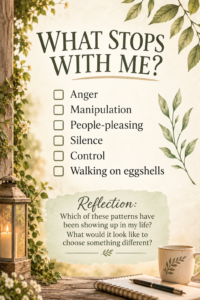
Want to go a little deeper? Download this free reflection worksheet and spend a few minutes identifying what you want to leave behind—and what you want to practice instead.” Link: what_stops_with_me_reflection