Identity, Triggers, People-Pleasing, Boundaries, and Growth
Family relationships are unique: they are often the people who knew us before we knew ourselves.
They remember our childhood personality, our mistakes, our awkward seasons, our insecurities, and the ways we learned to fit into the family. They hold pieces of our story that no one else has seen.
That can be a beautiful gift.
But sometimes it can also feel limiting.
Because while God may be growing and transforming us, our family members may still interact with the version of us they remember.
They may still see the child who struggled.
The teenager who reacted a certain way.
The sibling who always played a specific role.
The person who handled conflict, emotions, or relationships in a familiar pattern.
And sometimes the hardest part of growth is realizing:
The people who love us may not always recognize the person God is creating us to become.
“Do not conform to the pattern of this world, but be transformed by the renewing of your mind.”
— Romans 12:2
Growth means allowing God to renew not only our actions but also our understanding of who we are.
The Family Roles We Learn to Play
Every family develops patterns. Often, these patterns are created without anyone intentionally choosing them.
We learn:
- How emotions are handled
- How conflict is approached
- Who takes responsibility
- Who keeps the peace
- Who gets attention
- Who carries the expectations
Over time, these patterns can become roles.
Maybe you became:
The Responsible One
You learned that being dependable earned trust, so you became the person everyone could count on.
The Peacemaker
You learned to avoid conflict because keeping everyone happy felt safer than expressing your own needs.
The Helper
You became good at noticing what everyone else needed, sometimes before noticing what you needed.
The Strong One
You learned not to show weakness because others depended on you.
The Sensitive One
You felt things deeply and may have been labeled as emotional or “too much.”
The Achiever
You learned that success, productivity, or performance brought approval.
The Difficult One
Maybe you questioned things, challenged expectations, or expressed emotions others did not know how to handle.
These roles are not always bad. Many of them developed because they helped you belong, contribute, or survive difficult seasons.
But a role that helped you in one season may become a burden if you carry it forever.
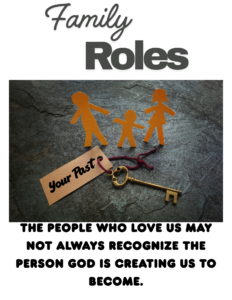
When Old Roles Become Old Wounds
The challenge is that families often relate to us based on history.
A family member may say:
- “You always overthink everything.”
- “You’ve always been the sensitive one.”
- “You’re the one who handles everything.”
- “That’s just how you are.”
- “You always make things harder.”
Sometimes these comments are harmless reminders of the past.
But sometimes they touch a deeper wound.
They can make us feel like:
- “They will never see that I have changed.”
- “I am stuck being the person I used to be.”
- “Maybe they are right about me.”
- “I need to prove myself.”
- “I need to earn their approval.”
This is where old roles can become triggers.
A comment made today can awaken feelings from years ago.
Suddenly, we are not responding as the grown adult we are now. We are responding from the younger version of ourselves who learned, “This is how I survive. This is how I stay loved. This is how I belong.”
Recognizing Your Triggers
A trigger is often a signal that something deeper is being touched.
Instead of only asking:
“Why did that bother me so much?”
Consider asking:
“What did this make me believe about myself?”
For example:
Someone questions your decision.
The deeper wound:
“I am not capable.”
Someone disagrees with you.
The deeper wound:
“My needs do not matter.”
Someone calls you emotional.
The deeper wound:
“My feelings are a problem.”
God invites us to bring those beliefs into His truth.
The question becomes:
“Is this who God says I am, or is this an old story I have carried?”
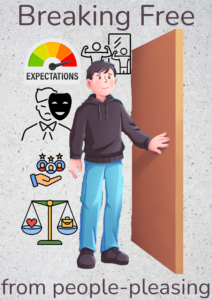
Breaking Free From People-Pleasing
Many people-pleasing patterns begin in relationships where acceptance felt connected to performance.
Maybe you learned:
“If everyone is happy, I am safe.”
“If I help enough, I will be valued.”
“If I avoid conflict, I will be loved.”
“If I meet expectations, I will belong.”
But your identity was never meant to be built on keeping everyone else comfortable. Jesus loved people deeply, but He was not controlled by people’s approval.
He served others, but He also withdrew to pray. He loved others, but He spoke truth. He cared deeply, but He did not allow everyone to determine His choices.
Healthy love does not require you to disappear.
“Am I now trying to win the approval of human beings, or of God?”
— Galatians 1:10
Setting Boundaries Without Losing Love
One of the hardest parts of changing family patterns is that boundaries can feel uncomfortable at first.
Especially if you were the person who always:
- Fixed problems
- Avoided disappointing people
- Took responsibility for others’ emotions
- Kept the peace at your own expense
A boundary is not saying:
“I do not love you.”
A boundary says:
“I love you, and I also recognize what is healthy and honoring to God.”
Boundaries may look like:
- Taking time before responding when emotions are high
- Saying no without excessive explanation
- Choosing not to participate in unhealthy conversations
- Allowing others to experience the consequences of their choices
- Communicating your needs respectfully
Jesus modeled boundaries.
He did not meet every demand.
He did not explain Himself to everyone.
He did not allow others to define His mission.
Boundaries protect relationships because they allow love to exist without resentment.
Becoming Who God Created You To Be
Breaking free from old roles is not about rejecting your family or pretending your past did not happen.
Your story matters.
Your family shaped you—but they do not have the final word about who you are.
God does.
The beautiful thing about God is that He does not just ask us to change our behavior. He transforms our hearts.
He takes the painful parts of our story and redeems them.
The responsible one can learn trust. The people-pleaser can learn freedom. The sensitive one can learn compassion without losing boundaries. The strong one can learn vulnerability. The overlooked one can discover they are chosen.
You are allowed to grow. You are allowed to heal.
You are allowed to become someone new while still honoring where you came from.
Reflection Questions
Take some time to reflect:
- What role did I naturally take on in my family growing up?
- What did that role teach me about myself?
- Is there a role I still feel pressure to maintain?
- What situations with my family trigger old emotions?
- What belief about myself do I need God to replace with truth?
- Where do I need healthier boundaries?
- Who is God inviting me to become?
Prayer: Becoming Who God Created Me To Be
Lord, thank You for the story You have written in my life. Thank You for the people who have shaped me, the lessons I have learned, and even the places where You are bringing healing.
Help me recognize the roles I have carried that no longer belong to me. Show me where I have looked for approval instead of resting in Your love.
Give me wisdom to honor my family while also becoming the person You created me to be. Help me set boundaries with grace, forgive with freedom, and walk confidently in my identity as Your child.
May I no longer be defined by old labels, old wounds, or old expectations.
May Your truth transform me.
Amen.