“Above all else, guard your heart, for everything you do flows from it.” — Proverbs 4:23
For many Christians, the word boundaries can feel uncomfortable.
We worry that saying “no” isn’t loving. We fear disappointing people. And before long, we wonder if setting limits means we’re failing to forgive, serve, or love like Jesus. Add in people-pleasing, and boy, do we have some tension with a hint of disappointment!
But here’s the thing: the Bible paints a very different picture.
Healthy boundaries are not walls built from fear—they are fences built from wisdom. They allow love to flourish while protecting what God has entrusted to us.
The truth is this:
You can love someone deeply without allowing unhealthy behavior to continue.
Let’s explore what Scripture teaches about boundaries and why they are an important part of healthy relationships.

What Are Boundaries?
Boundaries are healthy limits that help define what we are responsible for—and what we are not. This is not about cutting people off. I know there’s a trend of children cutting out parents. That is not what we are talking about here.
I had a wise bible study leader share how relationships and access should be seen as a home. Those allowed inside include your spouse and Jesus. The front porch is for those friends and family that you share more details of your life with. Then there are the people in your front yard; those may be like church groups or friends. Then you have those in the driveway or on the sidewalk that you meet out and have polite conversations with. Those are the acquaintances or work colleagues. I always joked with her, “What about those who are a few pastures away?” Because my home vision is always in the country, this is about my peace. She just always reminded me that those you invite into your yard are receiving access.
Boundaries communicate:
- What behavior is acceptable.
- What behavior is harmful.
- Where our responsibilities end.
- How we protect our emotional, spiritual, and physical well-being.
Most importantly, they aren’t about controlling other people. Instead, they’re about stewarding yourself well.
God has called you to love others, but He has never called you to abandon wisdom.
Love Without Enabling
One of the biggest misconceptions is believing that love means saying yes to everything.
However, biblical love is compassionate, but it is also truthful. Sometimes helping someone actually keeps them stuck. Enabling happens when we remove the natural consequences of another person’s choices, allowing unhealthy patterns to continue. So it’s worth asking.
Love asks:
- “How can I help you grow?”
Enabling asks:
- “How can I make this easier so you don’t have to change?”
Trust me when I say that enabling can look so Christ-like. Many tell themselves, ‘God helps those who need it’, so I should too. Imagine this: your sibling needs help paying for supplies, so you help out. But when you keep giving that person money to pay their bills, and then they come back asking for more. The person did not learn any lesson. They learned that you will cover their mistakes. More than likely, they are refusing to heal or avoiding an area where they need to grow, such as budgeting or recognizing the difference between needs and wants. You have to remind yourself you are not their Savior. The gospel of John teaches how Jesus is our Savior, and we need to get out of the way.
Jesus loved people unconditionally, but He never enabled sin. Instead, he welcomed sinners with grace while continually inviting them toward transformation. Love doesn’t ignore destructive behavior.
Rather, love lovingly tells the truth.
As Paul writes:
“Love does not delight in evil but rejoices with the truth.” -1 Corinthians 13:6
Grace and truth always belong together.

Jesus Modeled Healthy Boundaries
Many people imagine Jesus as someone who was endlessly available to everyone.
Yet when you read the Gospels, you see something surprising.
Jesus Walked Away.
Crowds constantly demanded His attention.
Even so, he often withdrew to pray.
“Very early in the morning… Jesus got up, left the house, and went off to a solitary place, where he prayed.” — Mark 1:35
Even when people were searching for Him, He didn’t allow urgency to replace obedience.
Jesus Said No
Just as importantly, not every request received a yes. Jesus knew His mission. People’s expectations did not control Him.
Sometimes He healed. Sometimes He waited. Other times He walked away.
Instead of being led by guilt, he was led by His Father.
Jesus Didn’t Chase Everyone
One of the hardest examples to accept is found in John 6. After Jesus gave difficult teaching, many disciples left Him.
However, he didn’t manipulate them into staying. He let people choose.
Healthy love leaves room for others to make their own decisions.

Wisdom Is Loving
Proverbs repeatedly connects wisdom with healthy relationships. Wise people know that love and discernment go together. Plus, you cannot control other people and what they choose to do. You can only control your reactions, thoughts, and the narrative you’re telling yourself and others.
Jesus Himself instructed His followers:
“Be wise as serpents and innocent as doves.” — Matthew 10:16
Because of this, biblical wisdom asks questions like:
- Is this relationship producing peace or constant chaos?
- Am I helping this person grow, or shielding them from responsibility?
- Am I acting out of love or guilt?
- Is this relationship drawing me closer to Christ or pulling me away?
Ultimately, love is never opposed to wisdom. Wisdom protects love from becoming unhealthy.
Protecting Your Peace
Protecting your peace doesn’t mean avoiding every difficult conversation. It means guarding your heart so that fear, manipulation, bitterness, and constant anxiety don’t become your normal. Remember that protection is not about walls. Walls create blindness; we walk in clarity
Philippians tells us that God’s peace guards our hearts and minds. Peace isn’t passive. It stands guard. Matthew 5:9 says, “Blessed are the peacemakers, for they will be called children of God.” Peacemaker, not peacekeeper: now there’s a BIG difference. Consequently, peacekeepers keep quiet so as not to hurt others’ feelings or create waves. Peacemakers are those who speak truth with love and find resolutions with those who want to with you.
Sometimes protecting your peace means:
- Limiting conversations that become abusive.
- Taking time to pray before responding.
- Saying no without apologizing for healthy limits.
- Stepping back from relationships that consistently dishonor God.
- Choosing forgiveness while also choosing wisdom.
Therefore, peace isn’t something we cling to selfishly. It’s something God gives us to steward faithfully.

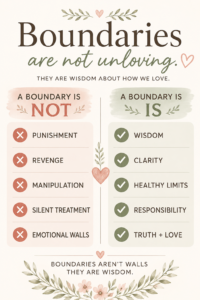
What Boundaries Are NOT
Healthy boundaries are often misunderstood.
For example, they are not:
- Punishment
- Revenge
- Silent treatment
- Manipulation
- Emotional walls
- Controlling someone else’s behavior
Instead, boundaries communicate:
“I love you, but I cannot participate in what is unhealthy.”
What Healthy Boundaries Sound Like
Instead of reacting emotionally, boundaries communicate calmly and clearly.
Examples include:
- “I’m happy to talk when we can both be respectful.”
- “I love you, but I can’t make that decision for you.”
- “I need some time to pray before giving an answer.”
- “I forgive you, but rebuilding trust will take time.”
- “I’m not comfortable with that conversation.”
Notice that boundaries focus on your response, not forcing someone else’s.
Reflection Questions
Take a few moments to honestly consider these questions:
- Where do I struggle to say no?
- Have I confused sacrifice with self-neglect?
- Am I trying to rescue someone from consequences God may be using to grow them?
- What relationships consistently steal my peace?
- What healthy boundary might God be asking me to establish?
Pray and invite the Holy Spirit to reveal where wisdom and love need to work together.
Biblical Truth
Setting boundaries isn’t a lack of love. In fact, it’s often one of the most loving things you can do. I want to encourage you, as though some people will see these boundaries as betrayal. Boundaries may even cause you to have anxiety, as you don’t want to fail a person you love or have them react negatively.
Healthy boundaries protect relationships from resentment, encourage personal responsibility, and create space for genuine love to grow.
Jesus loved perfectly. He forgave freely. He served sacrificially.
At the same time, he still rested, withdrew, said no, confronted sin, and protected His mission. Ultimately, following His example means learning that love isn’t measured by how much we tolerate; it’s measured by how faithfully we reflect God’s truth and grace. As a result, when we establish healthy, biblical boundaries, we don’t love people less.
We simply learn to love them with wisdom.
Prayer for Healthy Boundaries
Heavenly Father,
Thank You for showing me that love and wisdom belong together. Help me to love others with compassion while also honoring the boundaries You have called me to establish. Give me the courage to say yes when You lead me and the confidence to say no when necessary.
Guard my heart from fear, guilt, people-pleasing, and resentment. Teach me to protect the peace You have placed within me, not by withdrawing from others, but by walking in wisdom and truth.
Help me follow the example of Jesus, who loved deeply without compromising His mission or enabling unhealthy patterns. Give me discernment to know when to extend grace, when to speak truth, and when to step back.
May my boundaries never come from pride or anger but from a desire to honor You and cultivate healthy, life-giving relationships.
Teach me to trust that obedience to You is always the most loving path.
In Jesus’ name,
Amen.
Here is a free printable to see if there are areas where you may need boundaries: