If you’ve spent time in unhealthy relationships, healing can feel confusing.
You may find yourself wondering:
Why does peace feel… boring?
Why do I keep mistaking anxiety for love?
Why does consistency almost feel suspicious?
I’ve asked myself those questions.
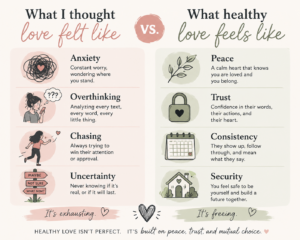
For a long time, I believed love was measured by how intensely I felt it. If someone occupied my thoughts all day, if the relationship was full of emotional highs and lows, if I constantly wondered where I stood—that must mean it was important. Cue the romantic comedy of your choice.

But somewhere along the journey, God began teaching me something different. Healthy love isn’t built on emotional intensity. It’s built on character, trust, choosing one another day after day, and most of all, it’s built on Christ.
The beautiful thing is that healthy relationships don’t just change how you’re loved—they change how safe your heart feels.
Here are seven things healthy relationships actually feel like.
1. Peace More Than Constant Excitement
One of the biggest surprises about healthy relationships is that they often feel… peaceful.
Now some people believe that’s boring. They panic because “I don’t want to settle.” I don’t want that boring life that I want to escape from. Love means excitement and thrill, right….? That’s what all the romance novels and movies portray to me! That’s what my heart desires!
A healthy relationship doesn’t mean there’s never excitement or the butterflies disappear. But your nervous system isn’t constantly sounding an alarm. The hypervigilance is always activated.
You don’t have to spend your evenings waiting for a text, analyzing a conversation, or wondering where you stand. Healthy love doesn’t keep you constantly guessing. It gives you room to breathe.
Instead, you know where you stand. Clarity is kindness.
That doesn’t mean every day is perfect.
It means uncertainty isn’t the foundation of the relationship.
Practical Example
Imagine your spouse or boyfriend says they’ll call after work.
Hours pass.
Instead of immediately assuming they’re losing interest, your first thought is probably:
“They’re probably still busy.”
Why?
Because they’ve consistently shown they’re trustworthy.
Trust changes how your mind responds.
Biblical Truth
“Let the peace of Christ rule in your hearts, since as members of one body you were called to peace. And be thankful.” — Colossians 3:15
God never intended love to be fueled by constant fear.
Peace isn’t boring. Peace is a gift.
2. You Feel Safe Enough to Be Honest
Healthy relationships make honesty easier—not because it’s comfortable, but because it’s welcomed.
You don’t have to have everything figured out or hide the parts of your story that feel messy. A healthy relationship gives you room to be honest about where you’ve struggled, both now and in the past, without feeling like you have to pretend to be someone you’re not.
You can say,
“That hurt my feelings.”
“I was wrong.”
“I’m afraid.”
without fear that the relationship will collapse. Safety doesn’t mean there are no hard conversations. Hard conversations are good; they are needed even when they are uncomfortable. Safety allows needed conversations to happen more. What I love even more than honesty is transparency. Transparency is more than honesty; it’s sharing information before it even has to be questioned.
It means honesty isn’t punished.
Practical Example
You forget an important date.
Instead of hiding it out of fear, you admit it.
Your partner may be disappointed, but the conversation becomes about understanding and repairing—not shaming and attacking.
That’s emotional safety.
Biblical Truth
“Instead, speaking the truth in love, we will in all things grow up into him who is the Head, that is, Christ.” — Ephesians 4:15
Speaking truth helps you grow closer to Christ. In whom you find your true identity.
Truth without love wounds. Love without truth avoids growth.
Healthy relationships make room for both.
3. Conflict Doesn’t Feel Like a Threat
Every couple disagrees. Healthy couples aren’t conflict-free. They’re repair-minded.
In unhealthy relationships, conflict often becomes about winning, keeping score, bringing up the past, threatening to leave, shutting down. I’m not proud, as I know that I have been in this cycle. Just because you are in this cycle doesn’t mean you cannot step out of it.
Healthy conflict looks different.
It asks,
“Help me understand.”
Instead of,
“How do I prove I’m right?”
Practical Example
One person feels unheard.
Instead of responding with,
“You’re too sensitive,”
their partner says,
“I didn’t realize you experienced it that way. Tell me more.”
Understanding comes before defending. This is a muscle that has to be practiced. Even during dating, this can be practiced. Instead of hearing a preference you don’t like or hearing a belief that makes you cautious, raising a red flag, you lean in and ask them to share more about it. Literally asking, “Can you tell me more about that?” shows you that you can get to know them at a deeper level so they can clarify instead of you filling in the unknown with your own explanations.
Biblical Truth
“Everyone should be quick to listen, slow to speak and slow to become angry.” — James 1:19
Listening is often one of the greatest acts of love.
4. Forgiveness Is Paired With Accountability
Forgiveness is one of the most misunderstood words in relationships.
Forgiveness can coexist with consequences, wisdom, and boundaries. It doesn’t excuse repeated harm, and it doesn’t require trust to be restored before someone has demonstrated that they are trustworthy.
Healthy forgiveness says,
“I’m choosing not to live in bitterness.”
Healthy accountability says,
“Let’s rebuild trust through changed behavior.”
Both are needed.
Grace without accountability becomes enabling. Accountability without grace becomes punishment.
God models both.

Practical Example
Someone apologizes for speaking harshly.
Instead of simply saying, “Sorry,” and repeating the pattern next week, they begin slowing down before reacting.
You notice change over time.
That’s repentance.
Biblical Truth
“Bear with each other and forgive whatever grievances you may have against one another. Forgive as the Lord forgave you.” — Colossians 3:13
Real forgiveness doesn’t ignore growth.
It encourages it.
5. You Grow Together Instead of Growing Apart
Healthy relationships don’t ask you to become less of yourself.
They encourage you to become more like Christ.
A healthy relationship makes room for both people to flourish. Your dreams aren’t minimized, your calling isn’t threatened, and spiritual growth becomes something you can encourage in one another. There is freedom to challenge each other with kindness, celebrate victories without comparison, and genuinely cheer for the person beside you.
Practical Example
One spouse decides to return to school.
The other adjusts routines, offers encouragement, and celebrates each milestone.
One person’s growth becomes a shared victory.
Biblical Truth
“As iron sharpens iron, so one person sharpens another.” — Proverbs 27:17
Healthy love helps both people become stronger.
6. You Have Freedom to Be Yourself
One of the healthiest feelings in a relationship is freedom.
You can laugh and be yourself. You can disagree without feeling threatened. You can nurture friendships, pursue your gifts, and keep growing into the person God created you to be.
Healthy love isn’t controlling.
It isn’t possessive.
It isn’t rooted in fear.
It’s rooted in trust.
Practical Example
You tell your spouse you’d like an evening with friends.
Instead of guilt or manipulation, they encourage you to enjoy the time.
Healthy love doesn’t require losing yourself.
Biblical Truth
“So if the Son sets you free, you will be free indeed.” John 8:36
Godly relationships reflect His heart.
They don’t imprison people. They help them flourish.
7. Consistency Matters More Than Grand Gestures
Movies celebrate dramatic declarations of love. I’m sure you can picture a few examples. I can already see someone holding a boombox outside your home.

Real relationships are built on ordinary faithfulness.
Showing up. Keeping promises. Doing the dishes. Praying together. Listening after a long day. Choosing kindness when no one is watching.
Grand gestures are memorable.
Consistency builds trust.
Practical Example
Your spouse makes your coffee every morning.
Checks in during the day.
Keeps their word.
Those small acts often say “I love you” louder than expensive gifts ever could.
Biblical Truth
“Therefore, my beloved brothers, be steadfast, immovable, always abounding in the work of the Lord, knowing that in the Lord your labor is not in vain.” 1 Corinthians 15:58 (ESV)
Notice how Paul describes love. Not with fireworks. With character.
Because character lasts.
A Final Thought
If healthy love feels unfamiliar, don’t be discouraged.
Many of us have learned to associate love with uncertainty, anxiety, or emotional highs. Healing often means retraining our hearts to recognize something different.
A relationship doesn’t have to be perfect to be healthy.
Healthy relationships still have disagreements. They still require forgiveness.
They still involve two imperfect people learning to love well.
But beneath all of that is something beautiful:

The kind of love that reflects God’s heart. And perhaps that’s the greatest reminder of all. Healthy love isn’t just about finding the right person. It’s also about becoming the kind of person who loves like Jesus. As we allow Him to transform us, our relationships begin to reflect His character more and more.
That kind of love is steady. That kind of love is healing. And it is worth waiting for.
Reflection:
Which of these qualities feels most familiar in your relationships today?
Which one feels the most unfamiliar—and why do you think that is?
What is one way you can reflect Christ’s love more intentionally in your relationships this week?
Heavenly Father,
Thank You for being the perfect example of love. Your love is patient, kind, faithful, and unchanging. As I learn what healthy relationships look like, help me remember that the greatest transformation begins with You.
Lord, I confess that there are times when I have confused excitement with peace, control with care, or approval with love. Renew my mind so that I see relationships through Your truth instead of my past experiences, fears, or expectations.
Search my heart and reveal any areas where I need to grow. Meet me in the places where fear has taken root and replace it with Your peace. Soften the places where bitterness has settled, and teach me to forgive. When pride makes it difficult to admit where I was wrong, give me the humility to apologize and pursue reconciliation where it is wise and honoring to You.
Lord, help me become the kind of person who reflects Your character in every relationship. Teach me to listen before I speak, to extend grace without abandoning truth, to set healthy boundaries with love, and to choose kindness even when it is difficult.
Give me discernment to recognize relationships that draw me closer to You and the courage to step away from patterns that are unhealthy or harmful. Help me never mistake chaos for passion or inconsistency for love. Instead, teach me to value peace, honesty, faithfulness, and mutual respect.
Where my relationships are already healthy, continue to strengthen them. Deepen our trust, grow our communication, and help us encourage one another to become more like Christ. May our words bring life, our actions reflect Your love, and our home or friendships become places of safety, joy, and grace.
For the areas of my heart that still need healing, I ask for Your gentle hand. Heal old wounds that influence how I give and receive love. Renew my mind with Your truth so I no longer see myself or others through the lens of past hurt but through the hope found in You.
Above all, remind me that no human relationship can fill the place that belongs to You alone. Help me rest first in Your love so I am free to love others without fear, striving, or insecurity.
May every relationship in my life point back to You and bring You glory.
In Jesus’ name,
Amen.